How it works
Sessions focus mainly on you as the parent or caregiver. We connect your observations and your child's strengths with one manageable approach.
Parents and caregivers of children ages 3–14 · Saskatchewan and Alberta · No diagnosis required
$40 non-refundable intake fee: clinician review and a 20-minute telephone consultation. Subsequent consultations are $170 separately. Joining the waitlist is free.
Who takes part
Preferably, one parent or caregiver takes the lead in sessions and tries the approach at home. Other caregiver involvement is discussed.
An initial child observation session helps inform our understanding. It does not mean your child attends every ongoing session.
Your capacity, family routines, communication and what your child finds manageable all inform the discussion.
Understanding first
The intake begins with your observations and relevant information you already have. The clinician reviews it before the included 20-minute telephone consultation, where you discuss recommendations and the most appropriate next steps.
We discuss any additional observation or assessment work, its purpose, appointments and cost before proceeding. A formal ADHD diagnosis or diagnostic report is not promised as part of a parenting session.
See how understanding informs your family's planYour full consultation, if recommended
We may explore your observations, your child's strengths, relevant information and what happens around difficult moments. The purpose is to inform the support your family needs, not to assume a diagnosis.
Where appropriate, an intervention report can organise the relevant observations, agreed strategies and next steps from the full consultation. Its purpose and scope are discussed with you.
This refers to a subsequent full consultation if recommended and booked, not the $40 intake review and 20-minute telephone call. Any work outside the agreed consultation and any additional fees are discussed beforehand.
This parent-focused consultation is not automatically a formal ADHD diagnostic assessment. See how your family's plan is developed.
The consultation process
Start with your observations, your child's strengths, relevant information and an initial child observation.
Discuss options with your clinician and rehearse an approach that fits your household.
Use the selected parent guide, workbook or reminder. Introduce a child handout when appropriate.
Bring back what you noticed. Keep, simplify or change the plan together.
Selecting an approach
Your clinician considers the situation, your child's development and any reasons an approach needs adapting. The STG Skill Selector helps organise the available options; it does not diagnose your child or decide your care.
Together, you rehearse the selected approach and decide what would be useful to notice. You do not need to use several strategies simply because a shortlist is available.
A short parent guide explains the strategy and the situation it is intended to support.
A seven- or eight-page workbook provides space to prepare, try the approach and review it.
A one-page Fridge Card offers a quick reference where the routine happens. It is also included in the workbook.
An age-appropriate page supports the child's involvement after you have tried that strategy.
Your child has a place in the work
You learn and try the approach first. Your clinician then considers whether a short child handout would help your child take part.
Materials differ for younger children (3–6), school-age children (7–12), and early teens within this program (13–14). Sessions primarily involve the parent or caregiver; your child does not have to attend every session.
See age-specific examplesBetween sessions
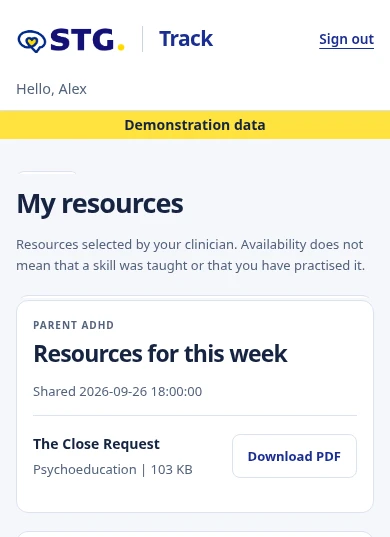
When access is arranged through your care, STG Track keeps selected materials in your own parent/caregiver account.
Find your current agreed practice and its attached documents.
Open the PDFs your clinician has shared, including resources sent without a practice plan.
You do not need to complete a diary just to receive resources. Your clinician explains what to record, who can see it and when it will be reviewed.
Use the private access link supplied by your clinician. If you need help locating it, contact the clinic through your agreed communication route. No new account is created by this page.
Access and resource arrangements are confirmed during care. Track is not continuously monitored and is not an urgent-response service.
Trying and reviewing
The plan clarifies the parent's action, any child involvement, ordinary safety boundaries and when to review. Participation is collaborative and voluntary. Ask for clarification or an adaptation when instructions are unclear, circumstances change or the plan is not workable.
Different activities can call for different responses to discomfort. Use the instructions agreed for that particular activity. Do not increase demands or continue an unsafe interaction just to finish a worksheet. Immediate danger requires local emergency help, not a portal message.
A few useful observations can be enough. Discuss whether recording itself adds pressure and whether a simpler approach would be better.
Questions about care
The $40 CAD intake fee is non-refundable. It covers a clinician's review of your intake information and a 20-minute telephone consultation to discuss clinical recommendations and the most appropriate next steps for your care. Any subsequent consultation is $170 and is charged separately. The intake fee is not applied to later sessions. Joining the waitlist is free.
If a full consultation is recommended and booked, a behaviour assessment may be completed and an intervention report may form part of that consultation, depending on your family's needs and the agreed scope. These are not automatically included in the $40 intake review or 20-minute telephone call. Additional assessment or report work and any extra fee are discussed before proceeding.
The number and frequency depend on your needs and the work agreed with your clinician. There is no requirement to complete all 20 strategies.
Yes, concerns about homework, routines and school demands can inform the conversation. School communication or written recommendations require relevant consent and a separate agreement about scope and fees.
No. We discuss when child-focused treatment, medical review or another assessment may be useful. Medication questions belong with the appropriate prescriber. Parent support has its own intake and availability.
We discuss their participation and what information can be shared. Do not share account passwords or assume that one caregiver's access covers another person.
A manageable family caseload
We support up to 5 active families per monthly cycle. This protects time for preparation, trying strategies between consultations and reviewing what fits. You do not have to demonstrate perfect follow-through: barriers and adaptations are part of the conversation.
Registration stays open while a family place is available. Once all five places are occupied, new requests go to the waitlist. Continuing families retain their places; a new calendar month does not automatically add five more families or end anyone’s care. Consultation frequency, next steps and any start date are discussed individually.
The $40 CAD intake fee is non-refundable. It covers a clinician's review of your intake information and a 20-minute telephone consultation to discuss clinical recommendations and the most appropriate next steps for your care. Any subsequent consultation is $170 and is charged separately. The intake fee is not applied to later sessions. Joining the waitlist is free.
Your next step
You do not need to have the whole explanation worked out. Tell us what has been difficult and we will clarify suitability, availability and the next step.
A support request is not a confirmed appointment or start date.