
Practical tools
Support you can return to
in everyday moments.
Your clinician helps you choose practical tools for the situations that matter most at home. Parent worksheets, reminder cards and visual routines support the work you do together in sessions.
Children aged 3–14 · No diagnosis required
$170 per session · Saskatchewan and Alberta
Selected around your family
The parenting resource collection includes 20 strategies across five areas. You receive the pieces relevant to your plan, rather than an entire set of assignments.
Understand
A short explanation of the concern and the approach you are considering.
Practise
A workbook or set-up sheet to help prepare and rehearse.
Remember
A brief card or prompt for use where the situation happens.
Five areas of everyday support
These 20 strategies are options to explore with your clinician. You do not need to work through the full collection. We choose according to your child’s developmental needs and your family’s priorities.
01
Getting started and cooperating
Explore how to make requests clearer and the first step more manageable.
- The Close Request
- Two Good Choices
- First Move, Fast Feedback
- Can’t or Won’t?
02
Homework and chores
Find a workable starting point, amount of support and way to keep going.
- Chore Cards
- The Homework Window
- Nearby, Not Hovering
03
Transitions, time and routines
Prepare for endings, mornings, bedtimes and outings.
- The Two-Step Countdown
- The Photo Routine Strip
- The Outing Plan
- One Habit, Then Stack
04
Big feelings and outbursts
Understand what happens before distress and practise supportive responses.
- The Run-Up Log
- Calm First, Talk Later
- Overdrive · Steady · Shutdown
- Answering the Critic
- The Brave Ladder
05
Rules, rewards and repair
Build clearer expectations, encouragement and connection after difficult moments.
- Five Rules, Fifteen Seconds
- The Small Token System
- Ten Minutes That Are Theirs
- Same-Day Repair
What a parenting action plan can look like
This example brings together a plan for one transition, a short parent reminder and an optional child card. Your own plan may focus on a different situation and use different supports.
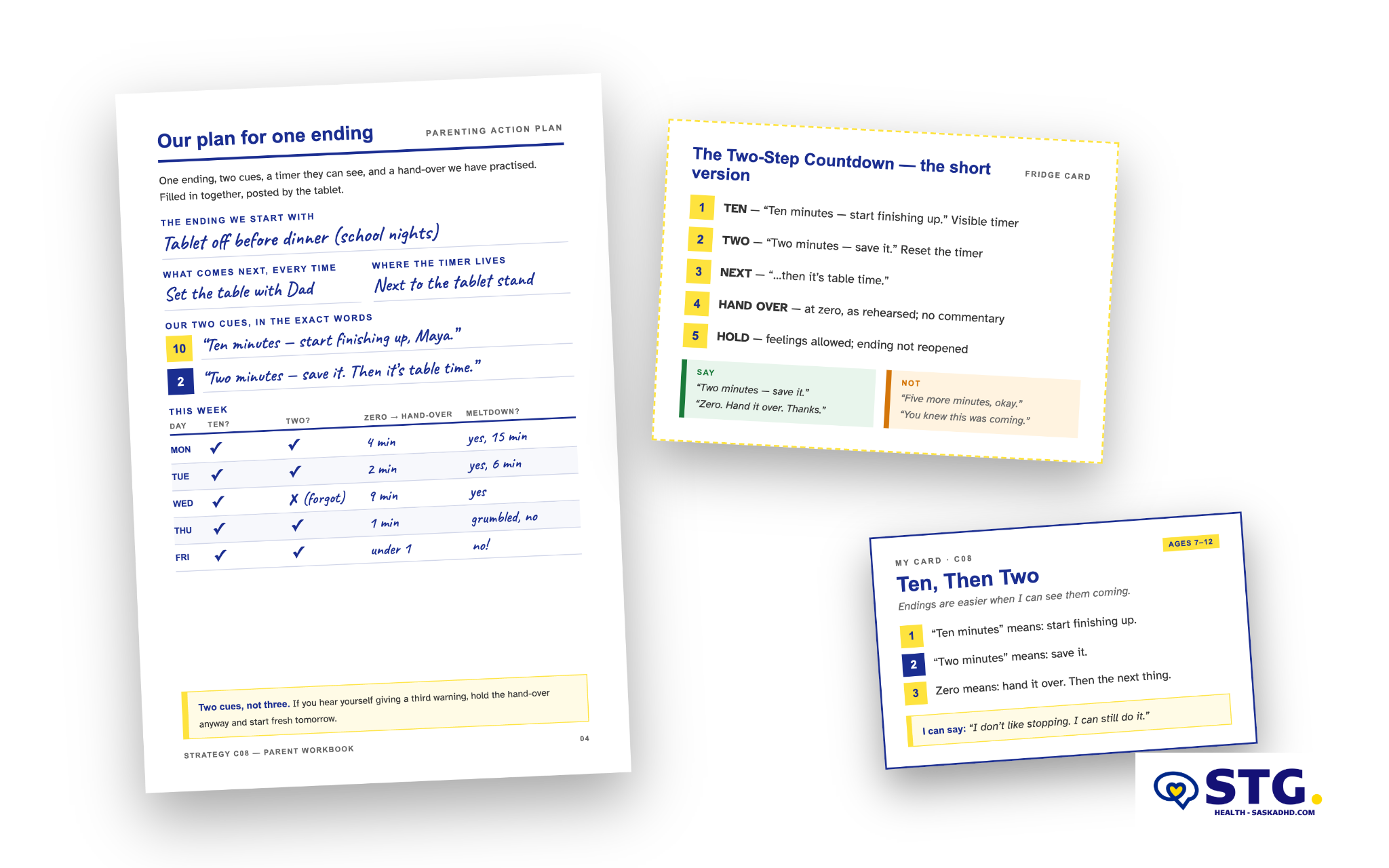
The detailed steps shown are examples for discussion with your clinician. You do not need to read or follow the worksheet to request support.
The clinician selects with you.
Your description helps guide the conversation. Your clinician uses the STG Skill Selector to consider relevant strategies alongside your child’s age, the situation, and any reasons an approach needs adapting. The shortlist supports clinical judgement; it does not diagnose ADHD or decide your care.
Some resources include optional child cards. Your clinician considers your child’s developmental level and whether a card would support the plan.
Your observations matter
We agree on something useful to notice, such as the number of prompts needed for one routine or how much strain a task creates. At review, we keep, adapt, or replace the approach based on your experience.
The materials draw on established practices and clinical adaptations. Individual STG tools are not presented as independently validated treatments.
Already working with us?
Use the resource access instructions provided by your clinician. If you cannot locate a selected resource, contact the clinic using your agreed communication method.
Start with one situation you would like help with.
Tell us what has been difficult for your family. Your request helps us understand the support you are looking for.
A waitlist request does not confirm an appointment.